
We use Hangul every day, yet few people stop to consider what kind of writing system it actually is. Many simply think of Hangul as "the script used for Korean," but from the perspective of linguistics and writing-system studies, Hangul occupies a unique place in human history.
우리는 매일 한글을 쓰고 읽지만, 정작 한글이 어떤 문자 체계에 속하는지 묻는다면 선뜻 답하기 어려울 수 있다. 많은 사람들이 한글을 단순히 "한국어를 적는 문자" 정도로 생각하지만, 문자학의 관점에서 보면 한글은 세계 문자사에서 매우 독특한 위치를 차지한다.
단어장
기사 본문
문자 체계는 크게 두 종류로 나눌 수 있다. 하나는 글자가 의미를 나타내는 표의문자이고, 다른 하나는 글자가 소리를 나타내는 표음문자이다.
대표적인 표의문자는 한자다. 예를 들어 '山'이라는 글자는 '산'이라는 의미를 담고 있다. 하지만 이 글자를 읽는 방법은 언어마다 다르다. 한국어에서는 '산', 중국어에서는 'shān', 일본어에서는 'やま'라고 읽는다. 글자 자체에 발음 정보가 포함되어 있지 않기 때문이다. 즉, 한자는 소리가 아니라 뜻을 기록하는 문자이다.
반면 한글은 소리를 기록하는 표음문자에 속한다. 그런데 표음문자도 다시 두 가지로 나뉜다.
첫 번째는 음절문자이다. 일본어의 히라가나가 대표적인 예다. 'か(ka)', 'き(ki)', 'く(ku)'처럼 글자 하나가 음절 하나를 나타낸다. 자음과 모음이 결합된 상태로 존재하기 때문에 각각을 따로 분리하기 어렵다.
두 번째는 음소문자이다. 영어에서 사용하는 로마자가 여기에 속한다. 'banana'라는 단어를 b·a·n·a·n·a처럼 자음과 모음 단위로 나눌 수 있는 것처럼, 소리의 최소 단위인 음소를 개별 문자로 표현한다.
한글 역시 음소문자이다. 그러나 한글은 여기서 한 걸음 더 나아간다.
한글의 가장 큰 특징은 '자질문자(Featural Alphabet)'라는 점이다. 자질문자란 소리의 물리적 특성이 글자 모양에 반영된 문자를 말한다. 한글의 자음은 발음할 때의 입과 혀의 모양을 본떠 만들어졌다. 예를 들어 ㄱ은 혀뿌리가 목구멍을 막는 모습을, ㄴ은 혀끝이 윗잇몸에 닿는 모습을, ㅁ은 입 모양을 형상화한 것이다.
더 놀라운 점은 글자 간의 관계에도 음성학적 원리가 체계적으로 담겨 있다는 사실이다. ㄱ에 획을 더하면 거센소리인 ㅋ이 되고, 글자를 겹치면 된소리인 ㄲ이 된다. ㄷ과 ㅌ, ㅂ과 ㅍ 역시 같은 원리로 만들어졌다. 단순히 모양이 비슷한 것이 아니라, 발음 방식의 차이를 글자 디자인으로 표현한 것이다.
세계의 대부분 문자들은 오랜 세월에 걸쳐 자연스럽게 변화하며 형성되었다. 그래서 왜 그런 모양이 되었는지 정확한 창제 원리를 알기 어려운 경우가 많다. 그러나 한글은 다르다. 창제자와 창제 시기, 그리고 창제 원리가 모두 기록으로 남아 있다. 특히 『훈민정음 해례본』에는 글자가 어떤 원리로 만들어졌는지 상세하게 설명되어 있다.
한자는 뜻을 담고, 히라가나는 음절을 담고, 로마자는 낱소리를 담는다. 그리고 한글은 낱소리를 담는 동시에 그 소리가 만들어지는 원리까지 글자 안에 담아낸다.
한글은 단순한 문자 이상의 의미를 가진다. 소리를 과학적으로 분석하고, 그 결과를 문자 형태로 구현한 인류 문자사의 걸작이다. 우리가 매일 사용하는 이 글자가 세계 언어학자들의 찬사를 받는 이유도 바로 여기에 있다.
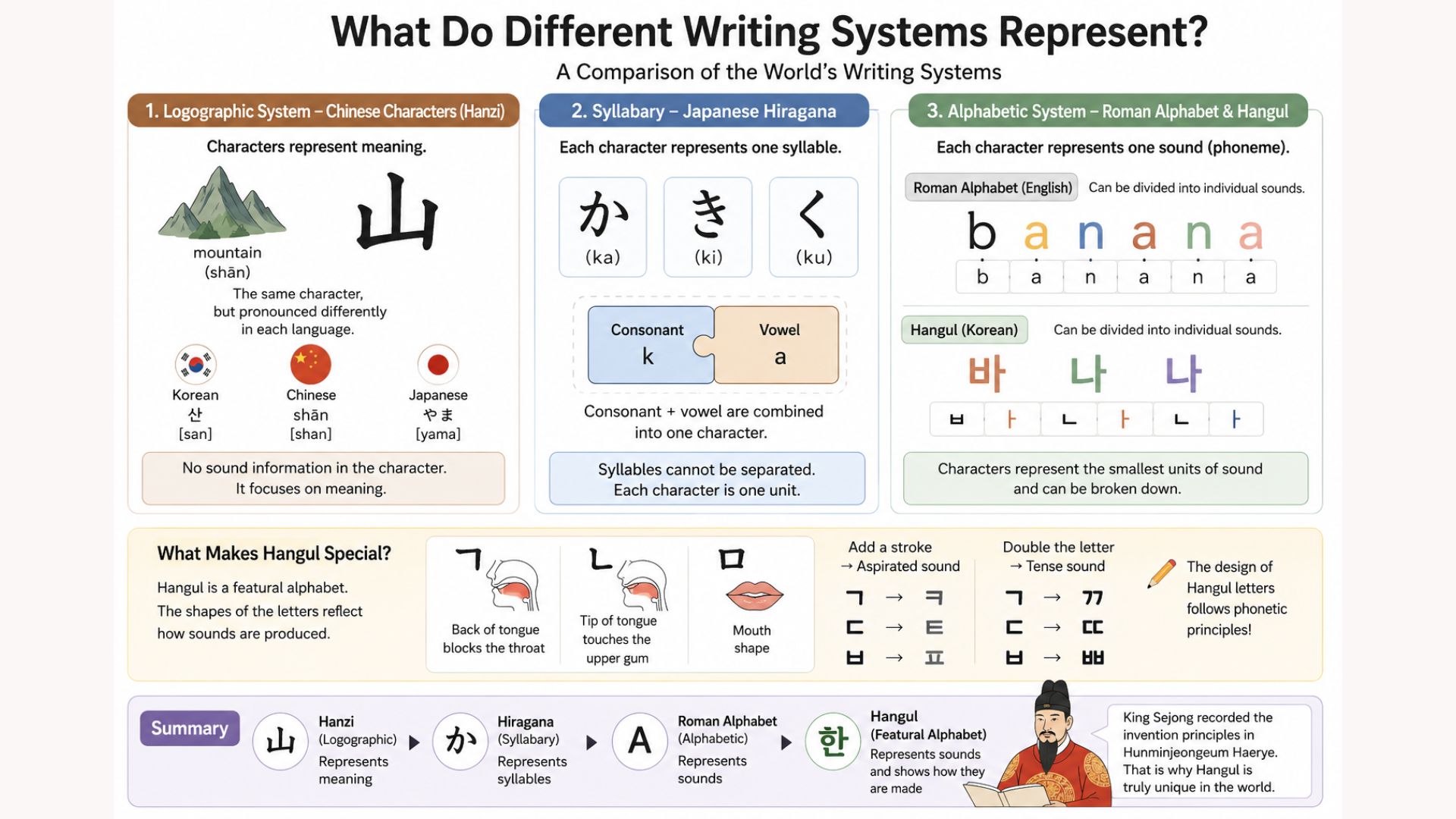
Writing systems can generally be divided into two major categories: logographic systems, in which characters represent meanings, and phonographic systems, in which characters represent sounds.
Chinese characters are a classic example of a logographic system. Take the character 山, which means "mountain." Although the meaning remains the same, its pronunciation varies across languages. In Korean, it is read as “san”; in Mandarin Chinese, “shān”; and in Japanese, “yama”. The character itself does not encode pronunciation; instead, it primarily conveys meaning.
Hangul, by contrast, belongs to the category of phonographic systems. However, these systems can be further divided into two types.
The first is the syllabary. Japanese hiragana is a well-known example. Characters such as か (ka), き (ki), and く (ku), for instance, each represent an entire syllable. The consonants and vowels are combined into single units and cannot easily be separated.
The second type is the alphabet, in which individual symbols represent the smallest units of sound, known as phonemes. The Roman alphabet used is one example, for in English a word like “banana” can be broken down into individual sounds: b-a-n-a-n-a.
Hangul also belongs to this second category, yet it goes one step further.
What makes Hangul truly remarkable is that it is a featural alphabet. In a featural writing system, the shapes of the letters reflect the physical characteristics of the sounds they represent. The consonants of Hangul, specifically, were designed based on the position and shape of the speech organs during articulation. For example, ㄱ represents the shape of the tongue root blocking the throat, ㄴ reflects the tongue touching the upper gums, and ㅁ is based on the shape of the lips.
Even more impressive is the systematic relationship between the letters themselves. By adding a stroke to ㄱ, the aspirated consonant ㅋ is created. Doubling ㄱ produces the tense consonant ㄲ. The same principle applies to pairs such as ㄷ and ㅌ, or ㅂ and ㅍ. The visual design of the letters directly reflects phonetic relationships.
Most writing systems in the world evolved gradually over centuries, making their original design principles difficult to trace. Hangul is different. Its creator, date of creation, and design principles are all documented in the Hunminjeongeum Haerye (The Proper Sounds for the Instruction of the People: Explanatory Edition), which describes in detail how and why the letters were created.
Chinese characters encode meaning. Hiragana encodes syllables. The Roman alphabet encodes individual sounds. Hangul, however, not only represents individual sounds but also incorporates the principles of their articulation into the very shapes of its letters.
For this reason, Hangul is far more than a simple writing system. It is a masterpiece of linguistic design—one that transformed scientific observations of speech into a practical and elegant script. This is why linguists around the world continue to regard Hangul as one of humanity's most extraordinary writing systems.

