
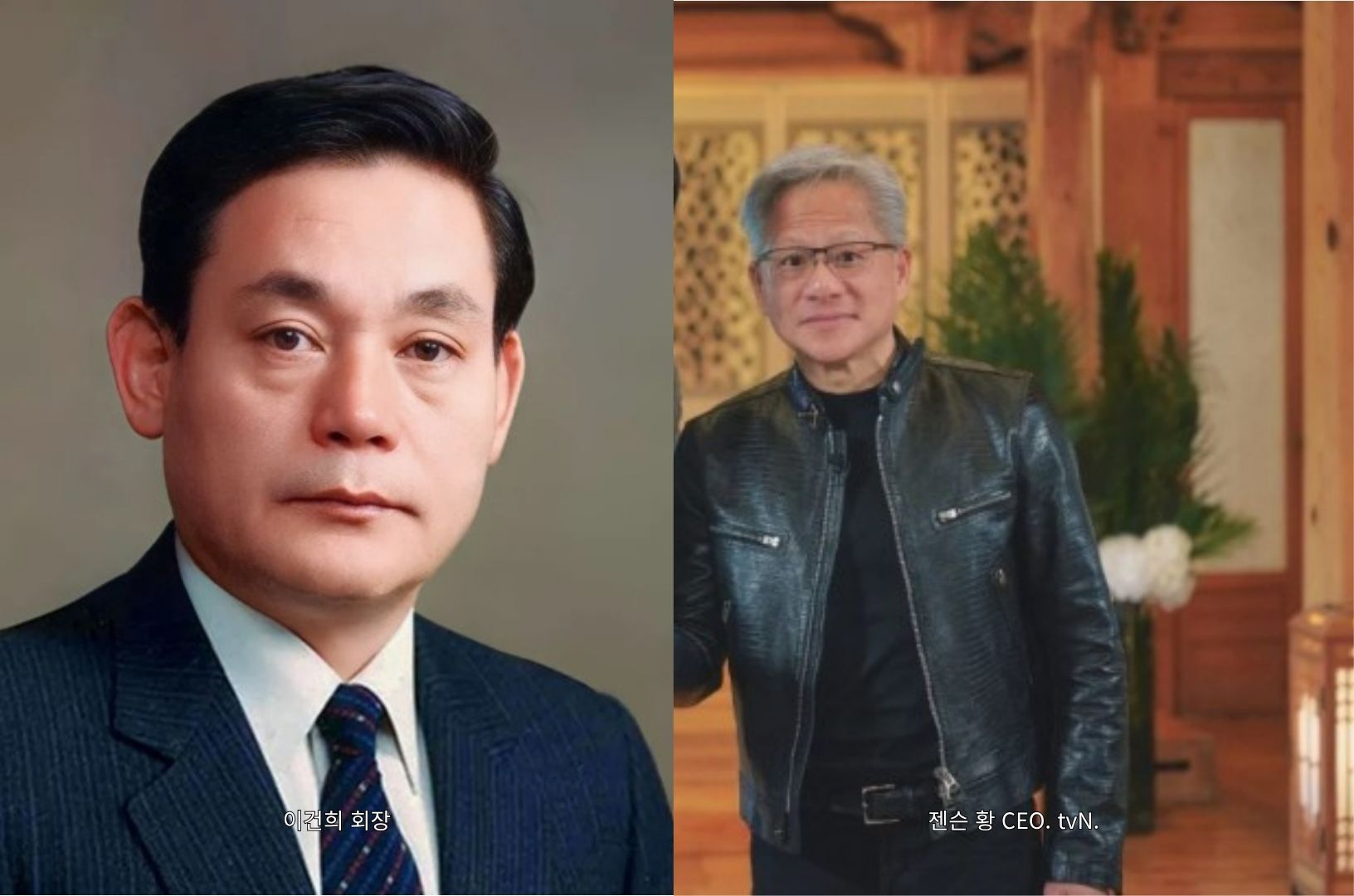
The head of one of the world's most valuable companies — one that holds up the entire AI era — sat down on a variety show and reached back thirty years. On June 10, 2026, Nvidia CEO Jensen Huang appeared on tvN's You Quiz on the Block. When he traced the origin of his bond with Korea, the first name he reached for belonged to a man no longer living: the late Lee Kun-hee, former chairman of Samsung.
전 세계 시가총액 최상위권에 오른, AI 시대를 떠받치는 기업의 수장이 예능 프로그램에 앉아 30년 전 이야기를 꺼냈다. 2026년 6월 10일 tvN ‘유 퀴즈 온 더 블럭’에 출연한 젠슨 황 엔비디아 CEO가 한국과의 인연을 이야기하며 그 출발점으로 떠올린 이름은, 이미 세상을 떠난 고(故) 이건희 삼성 선대 회장이었다.
단어장
기사 본문
황 CEO는 1996년 이건희 회장의 편지 한 통을 받고 한국을 처음 방문했다고 회상했다. 거기엔 두 문장이 있었다.
“대한민국을 광대역 인터넷으로 연결하고 싶다.”
“세계 최초로 비디오게임 올림픽을 열고 싶다.”
인터넷이 무엇인지조차 낯설던 시절, 무명의 그래픽칩 스타트업 창업자에게 보낸 손편지였다. 그 스타트업이 30년 뒤 AI 시대를 떠받칠 줄은 아무도 몰랐다. 황 CEO가 할 수 있었던 건 용산전자상가를 돌며 명함을 돌리고 상인들과 삼겹살을 먹는 일 뿐이었다. 이건희는 어떻게 30년 후를 보고 있었는가.
두 문장은 모두 현실이 됐다
이건희의 두 문장은 덕담으로 끝나지 않았다. 둘 다 삼성의 손으로 실현됐다.
‘광대역 인터넷 강국’은 2000년대 PC방 문화와 세계 1위 초고속 인터넷 보급률, 그 위에서 폭발한 게임 산업으로 구체화됐다. 황 CEO가 “한국 게이머들이 없었다면 엔비디아 기술이 세계적 현상이 되기 어려웠을 것”이라 말한 건 빈말이 아니다. 그래픽카드 성능을 극한까지 끌어내는 한국 게이머들의 수요가 엔비디아 GPU의 거대한 시험장이었다.
‘세계 최초 비디오게임 올림픽’은 더 직접적이다. 2000년 삼성전자가 주축이 되어 출범시킨 월드사이버게임즈(WCG)로 현실화됐다. ‘e스포츠 올림픽’이라 불린 이 대회는 2013년까지 14년간 전 세계를 돌았고, IOC 위원이던 이건희는 e스포츠를 올림픽 정식 종목으로 만들 뜻까지 품고 있었다. 편지를 쓴 지 4년 만의 일이었다.
그랜드 마스터 플랜은 한 번의 통찰이 아니다
이건희의 진짜 무서움은 한 번의 직감이 아니라, 20년·30년 단위로 미래에 베팅하고 그 베팅이 비웃음을 사는 긴 시간을 버텨낸 뚝심에 있다.
반도체가 그 증거다. 1974년 적자투성이 한국반도체를 인수하려 할 때 경영진 대부분이 반대했지만, 30대 초반의 이건희는 사재를 털어 지분을 사들였다. “한국이 무슨 반도체냐”던 시절이었다. 1992년 삼성은 64M D램을 세계 최초로 개발하며 메모리 1위에 올랐고, 그 자리를 30년 넘게 지키고 있다. 첫 베팅에서 결실까지 약 20년, 그것은 통찰이 아니라 버티는 시간이었다. 1993년 “마누라와 자식 빼고 다 바꾸라”는 프랑크푸르트 신경영 선언, 1995년 불량 휴대폰 15만 대를 직원들 앞에서 태운 ‘애니콜 화형식’도 모두 같은 뚝심에서 나왔다.
젠슨 황의 입에서 나온 ‘실패를 견디는 힘’
같은 방송에서 황 CEO가 꼽은 성공의 조건은 이건희의 그것과 정확히 포개진다. 그는 2006년 쿠다(CUDA) 플랫폼이 초기에 혹평받던 일을 떠올리며 말했다.
“아무도 믿지 않는 사업에 매달리기엔 20년은 너무 긴 시간이었지만, 결론에 대한 믿음이 있다면 끝까지 유지해야 한다.”
20년의 기다림, 아무도 믿지 않는 시간을 견디는 힘 — 1974년부터 반도체에 베팅해 20년을 버틴 이건희와 놀라울 만큼 닮았다. 어쩌면 1996년의 그 편지는 같은 종류의 인내를 이해하는 두 사람이 서로를 알아본 순간이었는지 모른다.
진짜 자산은 ‘세상을 꿰뚫는 시야’였다
오늘날 AI 시대를 떠받치는 핵심은 GPU와 거기 붙는 고대역폭메모리(HBM)다. 엔비디아가 설계하고 메모리는 한국이 만든다. 1996년 이건희가 심은 씨앗 — IT 인프라, 게임 생태계, 반도체 — 이 30년을 거쳐 지금 열매를 맺고 있는 셈이다.
그랜드 마스터 플랜은 거창한 청사진 한 장이 아니라 시야와 뚝심의 결합이다. 시야만 있으면 몽상가로, 뚝심만 있으면 고집쟁이로 끝난다. 이건희는 둘을 모두 가졌기에 종이 위 두 문장을 글로벌 반도체 강자와 IT 강국으로 바꿔놓았다. 미래는 예측하는 자가 아니라 그 예측을 끝까지 밀어붙이는 자의 것이다. 그리고 30년 뒤, 한 사람은 AI 시대를 이끄는 기업의 CEO가 되어 또 한 사람을 추억했다.
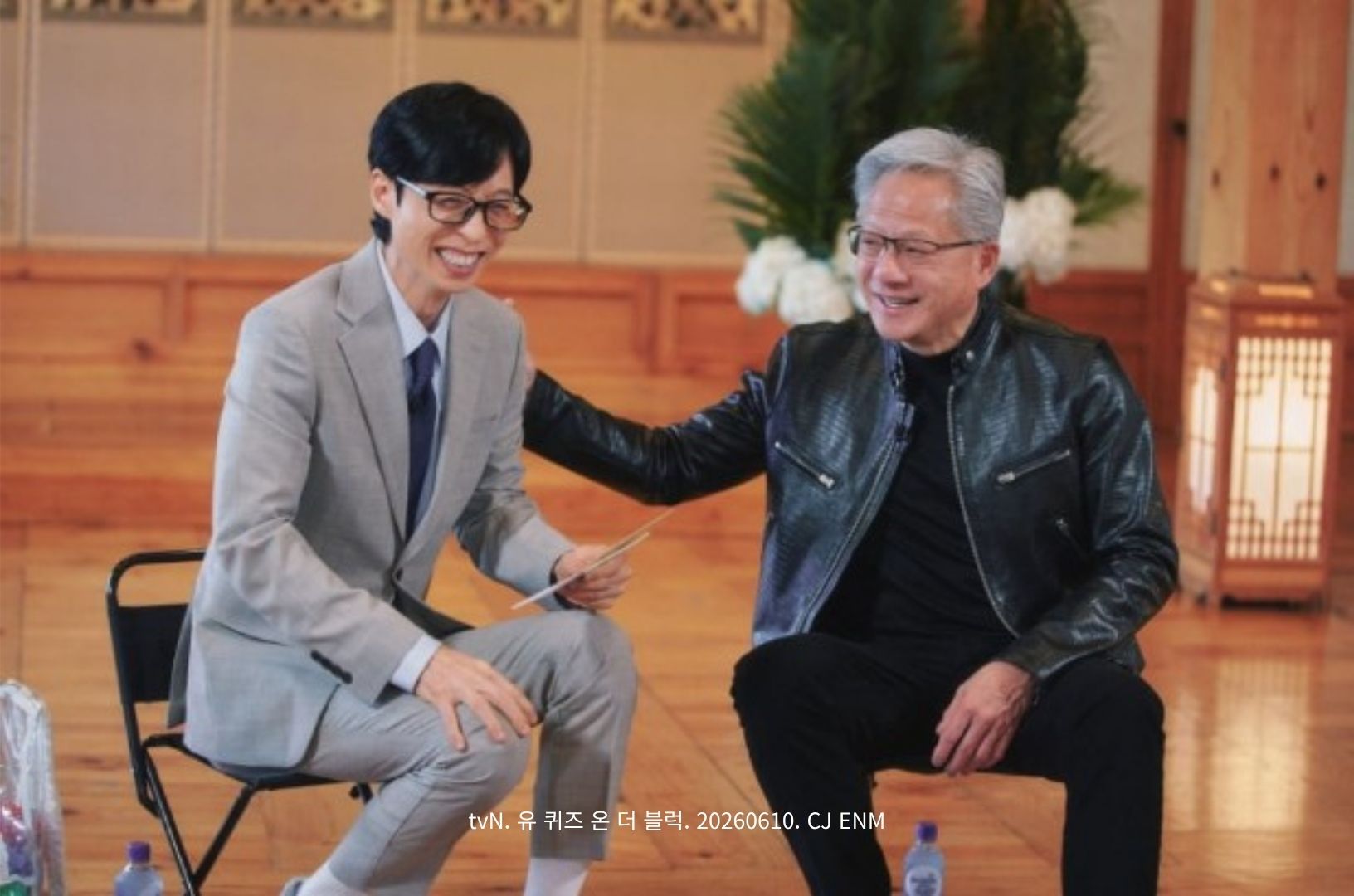
Huang recalled first visiting Korea in 1996, after receiving a letter from Chairman Lee. It held two sentences.
"I want to connect Korea with broadband internet."
"I want to host the world's first video game Olympics."
This was a handwritten letter — sent, in an age when most people had barely heard of the internet, to the founder of an unknown graphics-chip startup. No one imagined that startup would one day carry the AI era on its back. All Huang could do back then was walk the aisles of Yongsan Electronics Market, hand out business cards, and share grilled pork over a meal with the shopkeepers. How was Lee already seeing thirty years ahead?
Both sentences became reality
Lee's two sentences were no mere pleasantries. Both came true — and both by Samsung's own hand.
The "broadband nation" took shape in the 2000s through PC-bang (internet café) culture, the world's highest broadband penetration, and the gaming industry that exploded on top of it. When Huang said Nvidia's technology could never have become a global phenomenon without Korea's gamers, he wasn't being polite. The demand of Korean gamers — players who pushed graphics cards to their absolute limit — was the vast proving ground for Nvidia's GPUs.
The "world's first video game Olympics" is even more direct. It materialized as the World Cyber Games (WCG), launched in 2000 with Samsung Electronics at its core. Dubbed the "e-sports Olympics," the tournament traveled the globe for fourteen years until 2013 — and Lee, himself an IOC member, even nursed the ambition of making e-sports an official Olympic event. It happened just four years after he wrote that letter.
A grand master plan is not a single flash of insight
What made Lee truly formidable was not one stroke of intuition, but the grit to bet on the future in twenty- and thirty-year horizons — and to hold the line through the long stretches when those bets drew nothing but ridicule.
Semiconductors are the proof. In 1974, when Samsung moved to acquire the loss-making Korea Semiconductor, most of the leadership opposed it; Lee, then in his early thirties, reached into his own pocket to buy the stake. It was an era when people scoffed, "Korea? Making semiconductors?" In 1992, Samsung developed the world's first 64-megabit DRAM and climbed to the top of the memory market — a summit it has held for more than thirty years since. From the first bet to the payoff: roughly twenty years. That was not time spent on insight, but time spent enduring. The 1993 New Management declaration in Frankfurt — "Change everything except your wife and children" — and the 1995 "Anycall bonfire," when 150,000 defective phones were burned in front of employees, sprang from that same grit.
"The strength to endure failure" — in Jensen Huang's own words
On that same broadcast, the conditions for success Huang named overlapped almost exactly with Lee's. Recalling how Nvidia's CUDA platform was panned when it launched in 2006, he said:
"Twenty years is far too long to spend on a business no one believes in — but if you believe in the conclusion, you have to see it through to the end."
Twenty years of waiting; the strength to endure a stretch when no one believes you. It is uncannily close to Lee, who bet on semiconductors from 1974 and held on for two decades. Perhaps that 1996 letter was the moment two people who understood the same kind of patience recognized each other.
The real asset was the eye that saw through the world
What holds up today's AI era are GPUs and the high-bandwidth memory (HBM) bolted to them. Nvidia designs them; Korea makes the memory. The seeds Lee planted in 1996 — IT infrastructure, a gaming ecosystem, semiconductors — are bearing fruit now, thirty years on.
A grand master plan is not a single grand blueprint, but the marriage of vision and grit. Vision without staying power ends in daydreams; staying power without vision ends in plain stubbornness. Lee had both, and so he turned two sentences on paper into a global semiconductor powerhouse and an IT nation. The future belongs not to those who predict it, but to those who push their prediction through to the end. And thirty years later, one of them — now the CEO of a company driving the AI era — remembered the other.

